
Match Cliffside Park Previous Residents to an Era
Previous residents research works best when the source is chosen for its date and purpose. A present-day parcel search gives a current tax-list snapshot. A deed provides a recorded transfer. Directories and census sources may supply household clues, while maps and permits put the structure in context. The table does not turn those sources into one seamless list. It shows when each source is useful and where an older or missing online record must be pursued at the office, library, or archive.
| Source | Years it covers | Where held | What it shows |
|---|---|---|---|
| Bergen deed index | 1970-present online; older records exist but the earlier public index cutoff was not verified | County Clerk portal or counter | Recorded instruments, parties, legal description, recording date |
| NJ annual property data | Annual tax lists; portal years vary by dataset | NJ Property Explorer and local assessor | Tax-roll owner, mailing and situs addresses, class, assessment |
| Sanborn map set | 1911 local set | Library of Congress and Princeton sheet index | Structure, street, and land-use context, not occupants |
| Palisadian weekly | 1906 through May 1926 in digitized publication metadata | Library of Congress | Notices, deaths, street names, local events, legal advertisements |
| BCHS telephone directories | 1930-31 to 2018-19 with gaps | Bergen County Historical Society Library | Regional telephone and address listings when a title includes the borough |
| Federal census | Public through 1950 at the research date | NARA, HeritageQuest, and other library access | Household composition and enumeration-district context |
For an address last transferred after 1970, begin with the deed chain. For an earlier address, begin with block and lot, historic street wording, and the library or Clerk fallback at the same time. The digital cutoff does not mean earlier county records disappeared.
Note: Treat each year as a separate observation, because a directory, tax roll, and deed can describe different people and dates.
Start a Cliffside Park Previous Residents Search Today
Begin at the current physical address in the New Jersey Property Explorer and compare it with the Bergen County Parcel Viewer. Record the municipality, situs address, owner name, mailing address, block, lot, property class, and annual tax fields that appear. The tax mailing address can be outside Cliffside Park, and it is not proof that its recipient lived at the property. What matters for the next step is the exact name and parcel description that can be tested against a recorded instrument.
The map viewer supplies geometry and adjacent parcel context. The property explorer supplies annual tax fields. Neither replaces the deed. Keeping the modern address, legal description, and parcel key together also helps when a historic record uses a former street name or does not include a street address at all.
Follow Cliffside Park Deeds Backward
The backward chain is a title exercise. In the Bergen County Land Records Search, look for the current owner as grantee, the person or entity receiving a property. Review the matching deed and compare its legal description, block and lot, recording date, and prior-instrument reference with the parcel. Then search the seller, or grantor, as a grantee in an earlier period. Repeat that handoff, while searching spelling variants and entity names where the index calls for them.
- Write down the current owner, block, lot, municipality, and legal description from the property and deed records.
- Find the current owner as grantee and open or order the likely acquisition deed.
- Extract the grantor, grantee, recording date, book and page or document number, legal description, and any prior instrument reference.
- Search that grantor as a prior grantee, then repeat the same comparison for the next transfer.
- If the address vanishes, search the block and lot, subdivision, metes-and-bounds wording, prior owner, and nearby parcels before concluding the trail ended.
- Grantor
- The party transferring an interest in the instrument, often the seller in a deed.
- Grantee
- The party receiving an interest, often the buyer in a deed.
- Chain of title
- The sequence of recorded transfers used to trace ownership backward.
- Legal description
- The formal land description in an instrument. It can bridge a street-name change better than a modern mailing address.
Mortgages, assignments, and releases can help date a transaction, but do not prove that a lender, trustee, estate, or entity occupied the house. Keep those parties separate from the previous residents question.
Cliffside Park Previous Residents Before 1970
The verified public online land index begins January 1, 1970. Bergen County Clerk material says the county holds records spanning more than 300 years, but the research did not verify an exact earlier online or microfilm cutoff. For a pre-1970 Cliffside Park address, contact Land Records Management at 201-336-7036 or the Clerk main office at 201-336-7000. Ask about public terminals, deed books, indexes, legibility, and regular versus certified-copy fees, and provide the municipality, approximate date, block and lot, party names, and any book or page number.
The County Clerk BrowserView route provides alternate access to the public deed index.
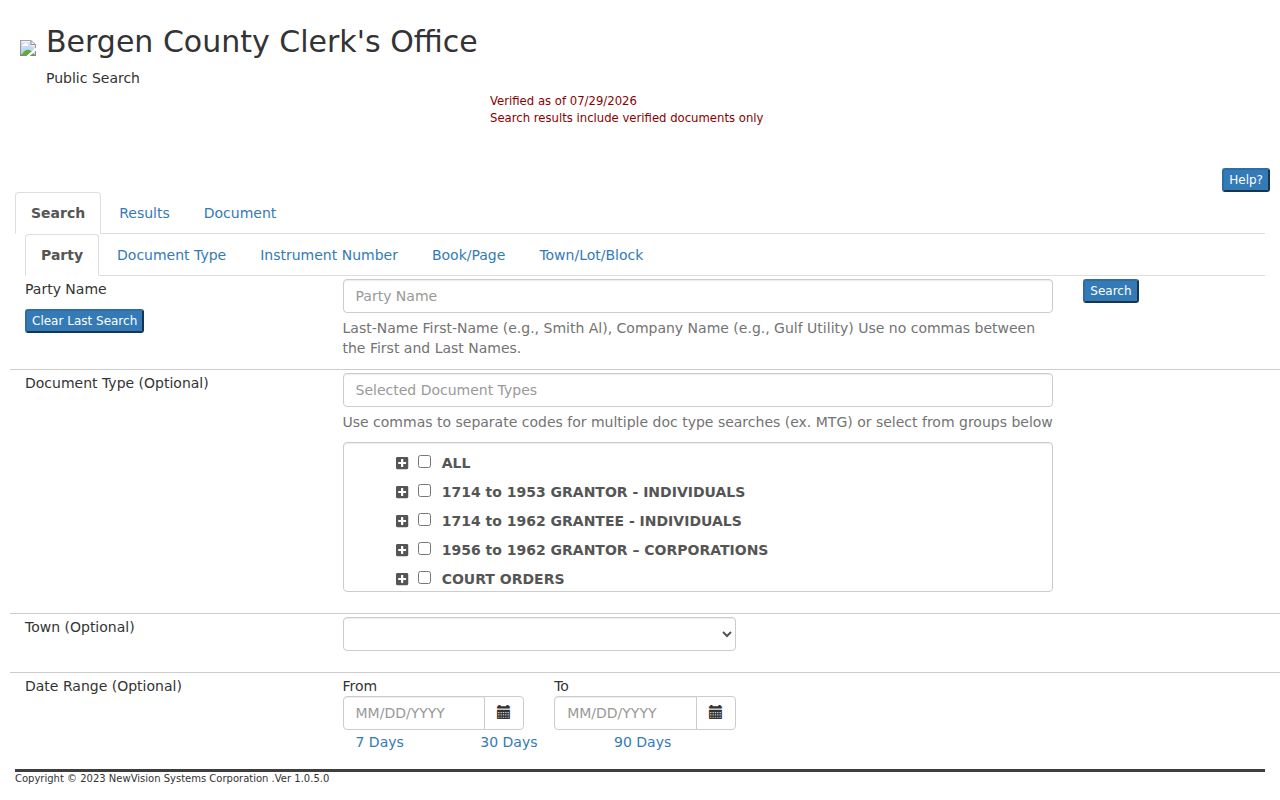
BrowserView offers an alternate path when the main land-record interface does not work in a standard browser. Its live field labels, payment rules, result cap, and image controls were not fully verified in the research, so an unclear hit should be confirmed with the Clerk instead of assumed to be a complete record.
Bridge Old Cliffside Park Street Names
One strong local warning comes from the Palisadian. A digitized 1926 ordinance notice says Hillside Avenue between Edgewater Road and Greenmount Avenue became Spring Street. Use that as a confirmed search bridge for that segment only. Other renaming or renumbering claims need the ordinance or municipal record that proves them.
The borough's older records may also appear under Cliffside, Palisade Park, Palisade, Palisades, or Grantwood. The Palisadian began in 1906, and the 1911 Sanborn title uses Palisades while listing Cliffside Park as a secondary location. Try the period name, old street name, block and lot, adjacent street, and neighboring names together. This is often more productive than forcing a modern address into an older index.
Note: Preserve the spelling from the original record, including an old place label, while also recording the modern form used to locate it.
Pair Cliffside Park Previous Residents With Households
Deeds explain title. They do not list every person who lived at a location. To investigate past residents, pair each ownership period with a directory, census schedule, newspaper notice, obituary, or probate lead. The Bergen County Historical Society Library holds regional telephone-directory runs, family files, clippings, maps, and related historical material. Its titles should be read for geographic scope before an address listing is treated as a Cliffside Park match.
- Select a directory year near the deed period and inspect any address-arranged section separately from the alphabetic section.
- Record the printed address, name, telephone or household notation, publisher, and year without expanding abbreviations by guesswork.
- Pair the result with the nearest available federal census, which is public through 1950 at the research date, and note its enumeration-district context.
- Use a local newspaper or obituary as a lead for relatives, a former address, or a date, then verify vital or estate details with the appropriate custodian.
The regional collections, year runs, and access cautions belong to the Cliffside Park city directory. Here, they serve a single address trail rather than a complete directory shelf. Probate can connect an owner to an estate or heirs, but the research did not locate a verified Bergen Surrogate public index or copy procedure, so use the county's official counter and court-record rules.
See 1911 Cliffside Park Structures
A 1911 Sanborn sheet can tell whether a building footprint, street, or land-use context existed in that period. It cannot name a resident. The Library of Congress catalog identifies a 75-sheet Palisades set with Cliffside Park among its secondary locations; the Princeton index identifies Cliffside Park sheets 21, 30-42, 51, and 52-54. Pair a sheet with deeds, directories, and the Palisadian rather than using a map as household proof.
The BCCLS genealogy eSources route provides the HeritageQuest access path through the New Jersey State Library. Login is required, and the research did not confirm a Cliffside Park-specific directory run in that database.
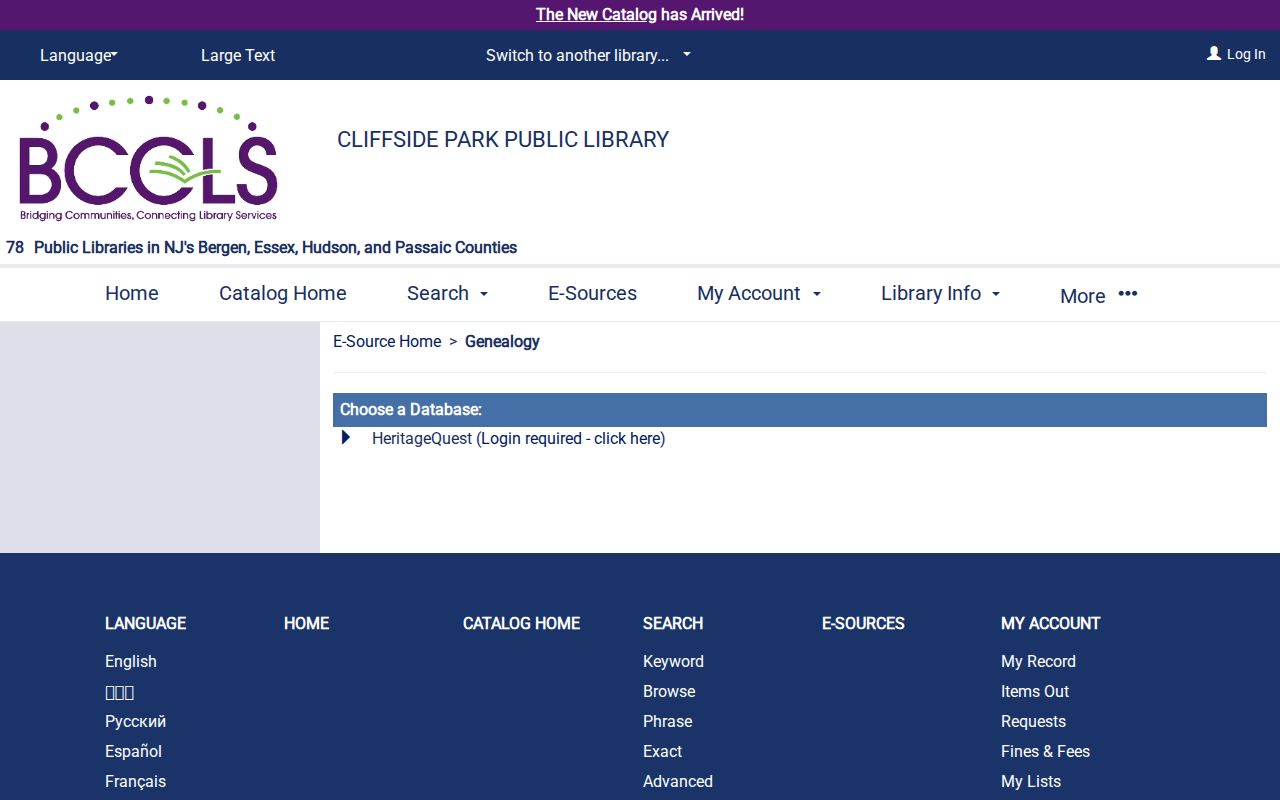
Use the Library of Congress Sanborn collection for the digitized map set and save a sheet number with every observation. The resource image above is a reminder that library database access and open map access are different channels, each with its own search scope.
Ask Cliffside Park Archives for Missing Years
No official Cliffside Park library house-history guide or paid research-service schedule was located. That gap makes a focused inquiry important. Ask for a former address, block and lot, deed chain, Sanborn sheet, directory years, newspaper notices, permits, tax cards, cemetery or obituary references, and the time range. The Johnson Public Library local-history room is a regional fallback for directories, maps, historic surveys, and related records; its Reference Desk is 201-343-4781.
Cliffside Park Library and BCCLS are the local first call. The official library page lists 742 Anderson Avenue satellite service and 201-945-2867. BCHS is another researched route, at the Ciarco Learning Center, 355 Main Street, Room 124, Hackensack, Tuesday 2-5 and by appointment. Its research contact is theBCHSLibrary@gmail.com. Ask staff to test Cliffside Park, Palisade, Palisades, and Grantwood variants rather than assuming a regional title has no relevant entry.
Limits on Cliffside Park Previous Residents Research
Previous residents research should preserve the distinction between a former owner, a tax mailing contact, a directory listing, and a household member. A property record may be tied to an entity or an estate. A permit applicant may be a contractor. A voter record is not a household roster, and protected voter addresses are withheld. Utility customer lists, DMV data, and unlisted household information are not public address-history sources.
Lawful use. Use Cliffside Park previous residents records for house history, family history, estate questions, and personal curiosity. Do not use public information to stalk, harass, intimidate, or harm a living person.
Keep copies or citations with the source, date, exact name spelling, and public boundary. That practice makes it easier to correct a mistaken address match and keeps a historical trail from becoming a claim about a living household.