
Cliffside Park Resident Lookup Records
No single search proves current residency in Cliffside Park. The official trail splits into lanes. An owner on a deed is one thing; a registered voter, a court party, and a name in a historical record are each different. Pick the record that fits your question. Start with roles, not guesses. The New Jersey Property Explorer helps when an address or parcel is known, while Voter Search answers a registration question for one named registrant at a time. The Judiciary search sorts public court material into separate modules, and one universal name file does not exist.
| Official record | What it can confirm | Cliffside Park route | Access boundary |
|---|---|---|---|
| Annual property data | Parcel owner, situs, block and lot | NJ Property Explorer or Bergen GIS | Free annual tax-list snapshot |
| Recorded land index | Grantor, grantee, instrument and recording date | Bergen County land records | Online index from January 1, 1970 |
| Voter status | Name, date-of-birth match and status | New Jersey Voter Search | One-person tool with redactions |
| Court docket | Party name, docket and division clues | NJ Judiciary or the municipal court | Module-specific public index |
| Vital record | Identity or family event where eligible | NJDOH, registrar or State Archives | Eligibility and time limits apply |
| Business or license filing | Official filing or professional role | New Jersey Treasury or licensing agency | Not proof of a home address |
Address questions deserve a two-step check. Compare the state property record with the county parcel map before chasing a deed. Name questions are different. Keep the spelling exactly as the system returned it. Then look for a second record family to confirm the person. Remember that a tax mailing address can belong to an agent. It can also belong to an owner who lives elsewhere. A docket can also name an attorney. It can name a witness, a business, or a party rather than a borough resident.
Note: Match the person, the place, and the date together. Treat any official result as one individual's only after that.
Cliffside Park Resident Lookup Starts With Roles
Frame the search as a name-plus-place question. Write down the full name, a known Cliffside Park street or parcel, and an approximate year. That small step keeps a same-name result from becoming a false match. For current registration, Voter Search takes the registered first and last name plus date of birth. Hyphens, spaces, changed surnames, and nicknames all matter. A failed match proves nothing about registration.
An address works differently. Use the Property Explorer and the Bergen County Parcel Viewer to record the situs, owner field, mailing address, and block and lot. The state data comes from local annual tax lists filed in January, so later changes may lag. The GIS map adds geometry and parcel context. Neither source lists every household member.
A legal role deserves the same care. A grantee may be a buyer, trustee, estate, or entity, and a license record can point to a regulated professional role. Test the role, not just the name. The right next step is the record that confirms it, and for an entire street rather than one person, the Cliffside Park street directory path fits better.
Cliffside Park Resident Lookup Court Modules
Court records take a division-specific search. The Judiciary's public-access case-jacket instructions lay out separate routes for civil, special civil, chancery and foreclosure, criminal, judgment, municipal, tax, and other material. Pick the division first. Then choose party name, docket number, or judgment as the entry point. The official guide also warns about a short-name rule. When both the first and last names have two characters or fewer, results are exact only, but a longer spelling in either field widens the range.
| Case-jacket control | How to use it |
|---|---|
| Search For Case division | Select the applicable court division before entering a name. |
| Search By Party Name | Use the party route for an individual or business. |
| Last name and first name | Required for an individual party search; middle initial is optional. |
| Docket or judgment tabs | Use a known docket or judgment route instead of a broad name search. |
| CAPTCHA | Complete verification before submitting the search. |
A public result can show the indexed party name, a docket or case number, the division or case type, or a no-record message. Filing and hearing dates vary by module. So do disposition labels. Not every filed image is online. Juvenile, sealed, expunged, adoption, and protected family material may be omitted or limited.
- Party name, indexed in the individual or business form searched.
- Docket or case number, the route to the particular jacket.
- Division or case type selected for the search.
- Judgment-search placement, where that route applies.
- Result status or no-record messaging, which must be read with the search criteria.
A docket needs its own check. Match its county, division, date, and role to the person you know. Public files travel a different path. The NJ Courts copy process covers requests, and the Cliffside Park Municipal Court administrator can route a local file request. Reach the local office at 201-313-2018 or court@cliffsideparknj.gov.
Note: A court index entry is procedural information, not a conclusion about what happened or who a person is.
Vital Records in a Cliffside Park Resident Lookup
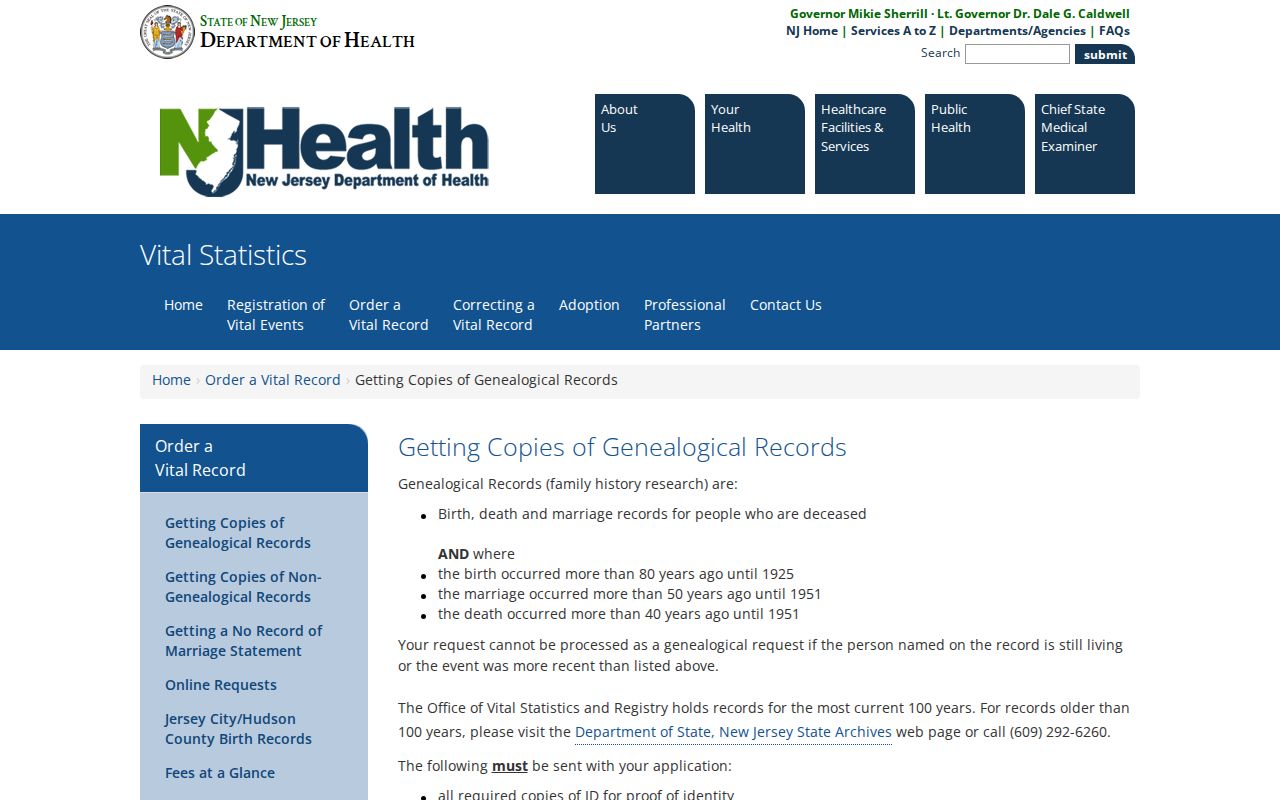
New Jersey offers no unrestricted current name index for births, marriages, and deaths. The NJDOH genealogical route opens only after time passes. Births qualify after 80 years, marriages after 50, and deaths after 40, subject to the agency's stated end years and deceased-person rule. A current certified copy is a separate request with its own relationship, identification, authorization, or court-order requirements.
The application guidance asks for plenty. Expect to give the person named on the record, the event place and year, your own identity, your relationship, and the copy type. Identifying fields help too. A mother's maiden name, a parent name, or a death-record SSN can matter where relevant. Supply only what the form requires. Mail requests go to the Office of Vital Statistics & Registry, and the local registrar is another route when the event occurred in Cliffside Park.
The state genealogical-record instructions draw a clear line. The two requests are not the same door.
Treat the form's relationship and identification options as a checklist. They are not a loophole for requesting a record outside the stated eligibility rules. Fees are set by the state. A first copy costs $25. An extra copy of the same record costs $2, and each added search year costs $1. Confirm current costs and processing rules before sending payment.
Confirming a Cliffside Park Resident
Solid verification rests on two independent record families. Keep their differences intact. An annual property card may tie an owner to a block and lot. A land-index entry, by contrast, names the recorded instrument and its date. A voter-status result can answer a registration question. Yet it is not a full voter file. Build the match from details that belong together. Use a name variant, the municipality, a date, a parcel identifier, a known relative, a former address, a court division, or a disposition.
- Start with the strongest known fact, such as a Cliffside Park address or the registered form of a name.
- Capture only the public identifiers needed to make a second official search, including block and lot, municipality, docket, or recording date.
- Check a second record family, such as a deed after a property card or a court docket after a precise name match.
- Ask the actual custodian for a copy, correction, or eligibility decision when the online index cannot settle the question.
- Docket
- A court's unique case identifier. It points to a case file and should be read with the court division and date.
- Index and image
- An index is a searchable list of record details. An image is the underlying filed or recorded document, which may have different access rules.
- Certified copy
- A copy issued and certified by its custodian. Eligibility, fees, and the reason for certification depend on the record type.
Record errors belong with their source. The election office corrects a registration, the assessor handles an annual tax-list issue, the Clerk answers for recorded documents, and NJDOH applies its own amendment proof rules. No office can fix another custodian's record. When an otherwise public Cliffside Park record is not online, send a narrow OPRA, court-copy, Clerk, election, vital, or archive request to the custodian that holds it.
Cliffside Park Resident Lookup Business Roles
Business and professional records can separate two people who share a name. Even so, they identify a filing or license relationship rather than a personal residence. The New Jersey Treasury Revenue route may lead to entity status material. It can include registered-agent and business-address information. The Consumer Affairs verification page offers person and business searches for regulated categories. The DOBI license search instructions describe name, reference-number, license-type, and status searches.
Requesting a certificate from Treasury means choosing a route. Options include a Name Control, FEIN, Entity ID, or certificate number. Name Control follows the form's first-four-character format rules. A status report can list an entity's agent, business address, filing date, annual report, officers or managers, and legal status. Those details separate similar names well. Still, they do not establish who occupies a Cliffside Park parcel.
Save each result with its issuing agency, record date, license type, and status. If the question is really about a person at a current address, go back to the record that answers it directly. That means the property, voter, deed, or court record.
Note: A business address or registered agent is an affiliation clue, not a personal-address finding.
Cliffside Park Names in 1804-1906 Files
Tracing an earlier family line? The State Archives naturalization material and Bergen County's Common Pleas series offer a dated local resource. Bergen records span 1804 through 1906. An index covers 1866 through 1906, and the County Clerk offers a $10 search route. Preserve original and anglicized spellings alike. A naturalization paper can supply a name form. That form sharpens a later directory, cemetery, newspaper, or deed search.
For family files, the Bergen County Historical Society Library is the strongest local historical contact. It holds church and cemetery material, diaries, maps, photographs, and telephone directories. Its staff asks researchers to use Cliffside Park, Palisade, Palisades, and Grantwood as place variants. Cliffside Park Library and BCCLS make a practical first call. They cover newspapers, yearbooks, obituary indexes, vertical files, and interlibrary-loan leads.
These sources can surface a former name, a date, or a historical address. Pair them with a current official source before concluding anything about a living person.
Cliffside Park Resident Lookup Privacy Limits
New Jersey's public-record rules have real boundaries. Voter materials withhold signatures, Social Security numbers, driver-license or non-driver numbers, and protected addresses. The federal Driver's Privacy Protection Act restricts motor-vehicle personal information. Court indexes can omit sealed, expunged, juvenile, adoption, and protected family material. Private association lists, utility accounts, and delivery data are not public parcel records.
The New Jersey Address Confidentiality Program gives eligible participants a legal substitute address. Daniel's Law also restricts covered home-address information in government websites and records requests. A missing address may reflect protection rather than an error. Do not try to reverse-engineer a protected location. A private service may hold a data issue. For that, the New Jersey Data Privacy Act FAQ describes the state's privacy-law context. The originating custodian remains the place to correct an official record.
Lawful use. Use a name search for a personal, lawful question and stop when protection applies. New Jersey anti-stalking and harassment laws apply to misuse of public information.
Commercial people-finder products often merge old tax data, court indexes, and other records. The result can be a stale address or a same-name blend. Compare any claim with the record custodian. Never treat an absent result as final proof. A person may still have a connection to Cliffside Park.