
Search Cliffside Park Streets by Address
A street directory works best as a record trail. Begin with the situs address. That is the physical parcel address the tax system uses. The next link is the block and lot, New Jersey's parcel identifier. From there, the annual property list supplies the tax-roll owner plus a mailing address. The Bergen County land index tests the recorded ownership chain. A mailing address can sit outside Cliffside Park. It shows where tax mail goes, not who lives at the property. For a full block, map each parcel on its own. Log what you find address by address.
- Find the situs address in the New Jersey Property Explorer. Try a normalized street suffix, leave off an apartment or unit, and select Cliffside Park Borough if the interface offers a municipality control.
- Open the Bergen County Parcel Viewer, zoom to the street segment, and click the parcel. Save the parcel identifier, block, lot, and map label that appear.
- Compare the tax-roll owner, mailing address, property class, assessed values, and prior-year taxes with the parcel. Annual tax data can lag a later transfer.
- Search the owner's name as both grantor and grantee in the County Clerk land-record index. Compare the legal description and recording date with the block and lot before accepting a deed match.
- For an earlier household, test an address-arranged telephone directory or regional city directory, then pair it with the deed period and a census or newspaper source.
This sequence keeps title separate from occupancy. A deed records a conveyance. It does not list everyone who used an address. A directory can hint at an occupant, but check its title, year, and geographic scope before trusting the clue.
Note: Write down the exact address format and parcel key first, since later deed and map searches may use different labels.
Read Cliffside Park Parcel Fields First
The state property explorer is the practical free entry point. It draws on local annual tax lists filed each January. So treat it as a dated tax snapshot rather than a live conveyance ledger. Preserve the owner field exactly as returned, including any entity suffix or punctuation. That exact spelling may be needed in the deed index later. The county and municipality fields matter too. They keep a same-named parcel from slipping into your Cliffside Park trail. That parcel might sit elsewhere in New Jersey.
| Property Explorer field | Use in an address search | Important boundary |
|---|---|---|
| Municipality and situs address | Locates the physical Cliffside Park parcel | Normalize street suffixes and directions |
| Owner and mailing address | Supplies a tax-roll name and correspondence location | A mailing address is not proof of residence |
| Block and lot | Links the map record to a legal-description search | Use both parts together when available |
| Property class and assessments | Describes annual tax data and classification | It is not a current sale record |
| Prior-year taxes | Provides a time-stamped tax field for comparison | Do not infer occupancy from it |
A parcel card may show an exemption or owner-occupancy indicator. Read it only as the classification claimed on that card. No Cliffside Park-specific field is described, and a missing field says nothing about a household. This narrow reading keeps the street directory useful when a property belongs to an entity, sits vacant, or holds more than one unit.
Map a Cliffside Park Street Parcel by Parcel
The Bergen County GIS department names the Parcel Viewer as the county map route. The department labels the viewer update May 2022. Use the map to see adjacent parcel shapes. Collect block-and-lot relationships one polygon at a time. It remains a map tool. No layer, export option, or popup field is promised in every browser session. Compare its geometry with the state property map. Do not assume the two systems update in step.
- Parcel
- A defined piece of land shown on a tax or GIS map, usually linked to a block and lot in New Jersey.
- Situs address
- The physical address assigned to the parcel. It can differ from the owner's tax mailing address.
- Plat
- A map or plan that shows land divisions and related features. A deed may refer to one through its legal description.
- Criss-cross directory
- An address-arranged directory, if a volume includes one, that can be checked separately from its alphabetic name listings.
For a question about one named street, select the first parcel, note its address and identifier, then move to the next. Adjacent polygons do not create a household or family connection. The county GIS office lists 201-336-6446 and gis@bergencountynj.gov at One Bergen County Plaza, fourth floor. Staff there can say whether a displayed field links straight to tax data or only supplies a parcel identifier.
Compare Cliffside Park Street Records
Several public systems key to an address, yet each describes a different event. Read these Cliffside Park street directory record sets side by side. No online index exists for every set. The documented fallback is a request to the borough department or its OPRA custodian. Give the address and a narrow date range. New Jersey's Open Public Records Act opens a request path. It does not replace the deed-copy process the County Clerk holds.
| Address-linked source | What it can add | How to reach it | Limit |
|---|---|---|---|
| NJ Property Explorer | Annual owner, mailing address, assessment, class, block and lot | Free state search | Annual data may lag a sale |
| Bergen GIS Parcel Viewer | Parcel shape, mapped address, adjacent parcels, available layers | Free county viewer | Live layer fields vary |
| Bergen land-record index | Deeds, mortgages, liens, releases, parties, dates, legal descriptions | Online from January 1, 1970; Clerk counter for earlier work | Address is often not the index key |
| Cliffside Park permits and code files | Construction, alteration, inspection, application, or correction clues | Borough department or OPRA request | No online permit or code index was located |
| Historic directory and Sanborn sources | Older address wording, telephone notation, structure context | Library, historical society, and map collections | Coverage varies and maps do not name residents |
For a permit request, ask separately for the application and permit number. Also request the inspection history, certificate of occupancy, and final inspection. Naming each item gives the custodian a usable record description. It also avoids implying something else. The contractor named in a permit never necessarily lived at the address.
Note: A public index can point to a document, but the custodian decides whether an image, regular copy, or certified copy is available.
Use Cliffside Park Permit Records by Address
Permit and code records date the building work behind an address, not the household. The borough publishes no online permit index. Its documented Building Department and construction-code route is the fallback. A narrow request can surface an application, permit number, construction description, inspection, certificate of occupancy, or final inspection by address and approximate year. A code-enforcement file may hold an address, violation, inspection, or correction history too. That material is public only after exemptions are applied.
Ask for each record component by name. A broad address file request invites confusion. A contractor or applicant may appear in a permit. That name is not evidence of residence or recorded ownership. Compare any permit date with the tax roll, deed, and map only for the question each source can answer.
Trace Cliffside Park Street Deeds
For the ownership side of a Cliffside Park street directory search, start with the Bergen County Land Records Search. The online index starts January 1, 1970. Look up the current owner as grantee first. Open or request the matching instrument. Note the grantor, grantee, recording date, book and page or document number, legal description, block and lot, and any prior instrument reference. Then search that earlier grantor as a grantee. Each repetition walks backward through recorded title, paper by paper, not through every household on the block.
The County Clerk land-record search supplies the recorded-title interface most Cliffside Park address work depends on.
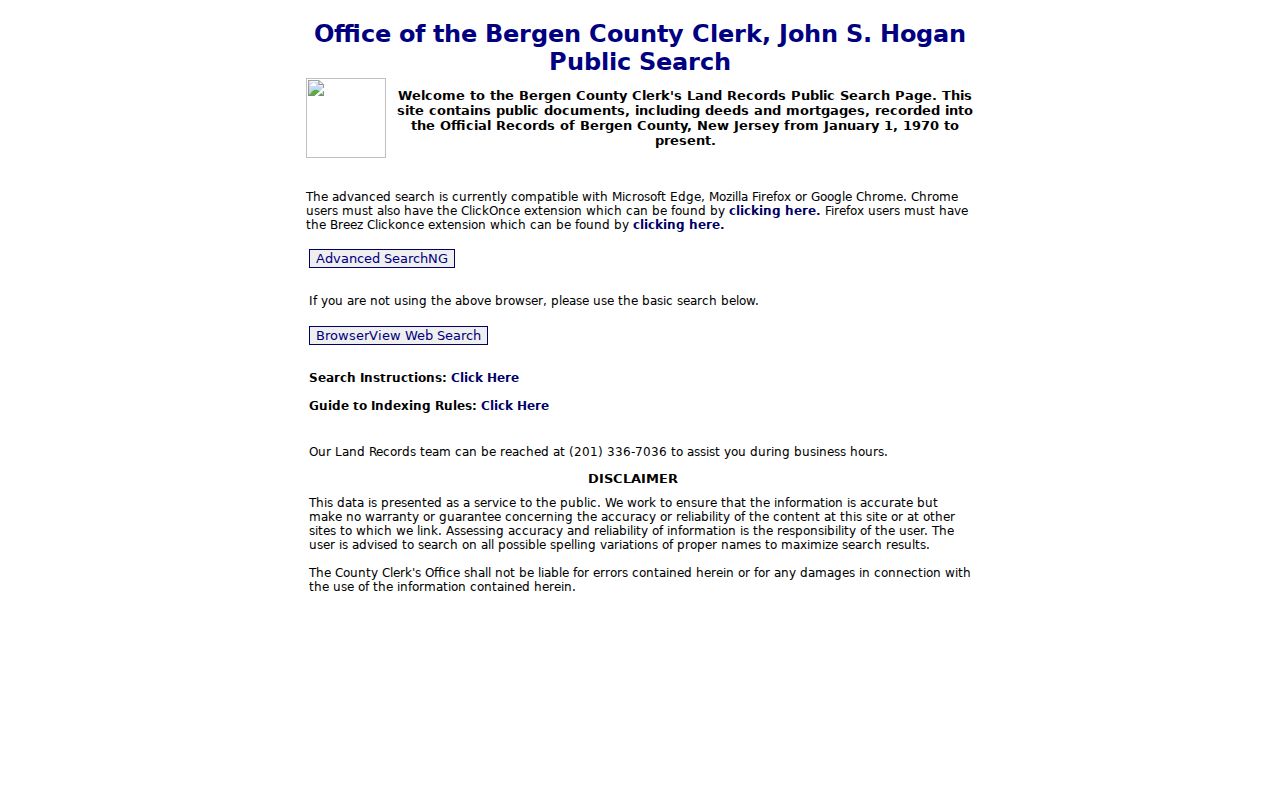
If the main interface stalls, try the alternate BrowserView route. It reaches the same land records through a setup some browsers handle better. Payment rules and image controls vary. Ask the Clerk when images stay unclear. For pre-1970 work or a certified copy, Land Records Management lists 201-336-7036; the Clerk main office lists 201-336-7000 and records spanning more than 300 years.
When a Cliffside Park Street Has Two Names
An old Cliffside Park address may not be missing at all. It may sit under a former street name or a period place label. A digitized 1926 Palisadian ordinance notice records that Hillside Avenue between Edgewater Road and Greenmount Avenue became Spring Street. That notice is a documented bridge for one segment. It is not proof of a borough-wide renumbering.
The local weekly began in 1906. Its notices pair well with a deed search. Check both old and modern street names. Then compare the legal description, block and lot, adjacent streets, and nearby names to decide whether two references mark the same spot. Before the 1920s, also search Cliffside, Palisade Park, Palisade, Palisades, and Grantwood as historical place labels.
Note: Do not generalize one ordinance notice into a claimed address change without the relevant ordinance or municipal record.
Read Historic Cliffside Park Street Listings
Old street research needs the right volume. The Bergen County Historical Society telephone-directory guide lists regional runs from 1930-31 through 2018-19, with gaps. Some titles cover broader Bergen or neighboring cities instead. They may skip borough addresses entirely. Check the title page first.
The Johnson Public Library Local History page is a second regional route. Its city-directory runs are chiefly Hackensack. A few railroad-published directories add towns north on the rail line. Test a volume for Cliffside Park before trusting a missing name. For a longer historical household trail, the collections are described on the Cliffside Park city directory page.
Copy details exactly as printed. Street number, older street name, telephone exchange, household notation, publisher, and year all matter. Pair each directory clue with the deed legal description and the 1911 Sanborn set before naming a past household.
Use Cliffside Park Voter Records Carefully
New Jersey's Voter Search checks one registrant at a time. It asks for a name and birth date. It cannot browse a street. A full Bergen voter list takes a separate written request through the County Clerk voter-list page. Published rates run $0.25 per district for registered-voter lists and $0.25 per page for mail-in ballot lists, so confirm the current quote, release format, and request contact before ordering.
Election records carry statutory redactions. Signatures, Social Security numbers, and license numbers stay out. Ballot choices are never disclosed. Registration is not universal either. A name in a court or business record does not prove a residence on the street.
Limits of a Cliffside Park Street Directory
A Cliffside Park street directory shows a public record path. It cannot list everyone tied to a location. Tax and deed records may name a recorded owner. They may also list a representative or an off-site mailing address. Visitors and other household members stay invisible. DMV records, utility-customer lists, delivery records, and private-club rosters sit outside the public property chain. Unlisted household data sits outside it as well.
Lawful use. Address records support personal research, family history, property questions, and civic curiosity. Do not use information from a Cliffside Park street directory to stalk, harass, intimidate, or harm anyone.
Sometimes the goal shifts from a street to one person. Use the name-based tools and limits on the Cliffside Park resident lookup page. Note the source and date each time. A partial record should never harden into a household claim.